

Human brain is one of the most complex mechanisms in the world. The world sends the environment tremendous quantities of information to it every moment. There is a combination of sounds, appearances, feelings, memories, physical sensations that are received at the same time. However, in spite of the continuous input of information, the brain becomes effective in processing the information and enables people to think, act and react almost immediately.
Parallel processing psychology is one of the outstanding mechanisms of this impressive capacity. This theory describes how the brain is able to process a number of information simultaneously instead of interpreting them in a number of successive order. The knowledge of parallel processing is a useful insight into the behavior of cognition, learning, memory, perception, and emotional responses. It also assists researchers and mental health practitioners to learn how the brain promotes complex behaviors and the mental process.
What Does Parallel Processing mean in Psychology?
Parallel processing is a process that involves the brain being capable to process multiple streams of information at once. The brain does not work sequentially in such a manner that it finishes one task and then moves to another but rather, it disperses information in various neural networks which operate simultaneously. To consider, when an individual views a face, the brain does not process each feature altogether in a sequence. Rather, the color, shape, motion, and expression of emotion are digitized by various parts of the brain at the same time. In a few moments these constituents are added up to create the full picture of the face by the brain. The cooperation between these activities enables people to be able to react fast and precisely to their surrounding. Life would be extremely slow and inefficient without parallel processing and thus driving, reading or even having conversations.
The Network of Special Regions of the Brain.
Parallel processing is based upon the collaboration of numerous special areas in the brain. These areas are tasked with the analysis of various forms of information. As an example, the visual signals are dealt with in certain parts of the brain and the sounds, language, or emotional messages are in other ones. When several sensory inputs are produced simultaneously, these regions are activated and they communicate by connecting with one another via the neural pathways. The distributed system can make the brain process complex experiences with amazing speed. It also enables one to carry out several cognitive activities without having to think about each process that is incorporated.
Parallel Processing of Perception.
The best place where parallel processing is evident is the perception. As people see what is around them, the brain processes visual information by a number of different pathways. One pathway establishes processing of the shape and identity of objects and the other one establishes processing of movement and spatial relationships. Such mechanisms take place simultaneously and lead to integrated knowledge of the surrounding. Like, when a person sees a moving car the brain instantly identifies its colour, shape, speed, direction amongst others. This quick interpretation can make people respond accordingly and have a sense of the possible changes in their environment.
The role of Parallel Processing in Learning.
Learning is a process of taking new knowledge and incorporating it into the already known knowledge. Parallel processing is a very critical part of the process as it enables the brain to process various parts of information simultaneously. The brain is able to read a sentence and at the same time it does not only identify letters, but it takes the words, processes grammar and draws a meaning of the passage. These takes place in coordination and not isolated. Due to this efficiency, people are able to grasp difficult content fast and memorize at a better rate. Pattern recognition is also facilitated by parallel processing and which is crucial in skill development like learning language and solving problems.
Parallel Processing and Role in Memory.
Parallel processing is highly relevant in the formation of memory. During an event that happens to individuals, the brain is able to encode various elements about the experience at the same time. Sensory information, emotional states, context and personal interpretations are all processed in parallel and held in interdependent neural networks. When the individual later recalls the memory the brain reactivates these networks to give the experience a reconstruction. It is this interconnected store of memory that is why some sight, sound or smell can be used to create strong memories. Since various elements of an experience were treated as a group, applying any of the elements would lead to recalling the whole memory.
This requires Brain Coordination and Processing of Emotions.
Parallel processing is also involved in emotional responses. The brain also assesses external stimulus, domestically felt physical conditions, and historical experience at the same time to determine the manner in which the brain will respond emotionally. Indicatively, whenever one is faced with a stressful event, the brain reacts very fast and analyzes perceived threat and past experience by initiating physiological response like the heart rate. Meanwhile, the situation is being interpreted by the cognitive parts of the brain, in a logical way. All this emotional and cognitive processing leads to effective reaction by people to challenges and their awareness of the surrounding world.
Examples of Parallel Processing in our Everyday.
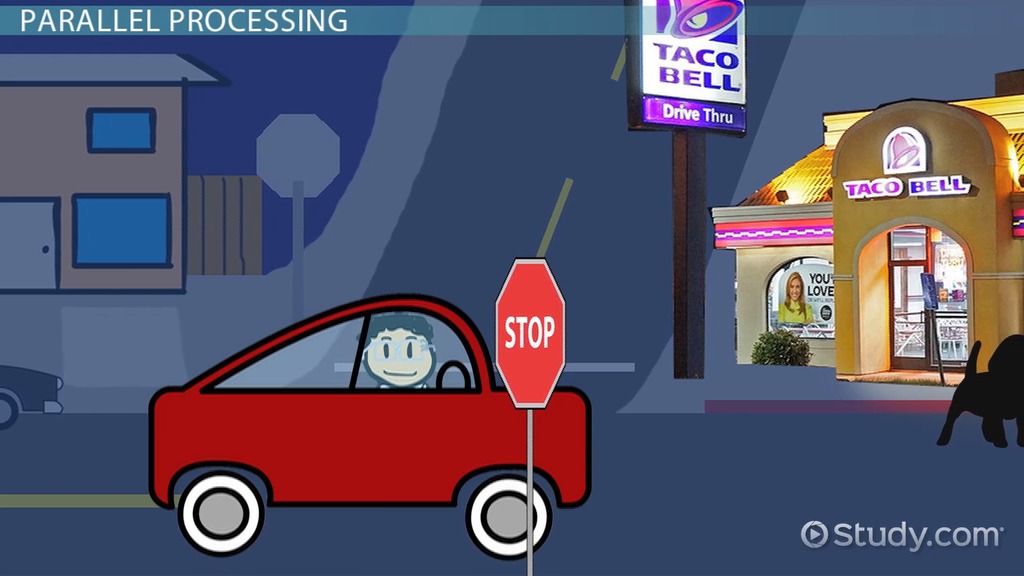
Parallel processing exists every day in normal works. Numerous activities that can be considered being automatic involve the interaction of several brain systems. An example of this is driving. When people are driving, they observe the road signs, control the steering wheel, change the speed, pay attention to the sounds that surround them, it may happen that they also talk. All this happens at the same time with the synchronized work of the brain. Equally, when individuals socialize they read facial expressions, hear verbal words, evaluate tones of voice and guess what to say at the same time. Parallel processing renders these interactions to be natural and effortless.
Cognitive Efficiency and Parallel Processing.
The brain is cognitive efficient because it is able to process information simultaneously. The brain allocates tasks to several systems as opposed to one process completing before others start. This efficiency enables one to be able to do complicated-like behaviors with a high level of accuracy within a short period of time. It also assists in saving mental resources by saving on time taken to gain insight into the information and make a decision. Parallel processing in lots of respects forms the basis of the advanced cognitive capabilities like reasoning, creativity and problem solving.
Difficulties Does processing systems disrupt.
Even though parallel processing is extremely efficient, the information processing can be interrupted through disturbances in the brain networks. Some neurological or mental disorders can disrupt the interaction between brain parts. In such a case, one can have problems with attention, perception, or memory. Researchers examine these disruptions in a bid to understand more of how the brain is able to organize information and how thinking may be enhanced either via a treatment or rehabilitation process. The developments in the neuroscience field are still demonstrating the role of neural pathways in efficient information processing, as well as how the mechanism can be used in a targeted intervention in order to restore the balance in the brain.
How Parallel Processing Relates to Neuroscience in the 21st Century.
Contemporary neuroscience studies have a lot of dependence on the concept of parallel processing to elaborate on the manner in which the brain carries out complex functions. Technologies of brain imaging have demonstrated that several parts of the brain become active at any given time when the individual is undertaking a cognitive task. The results support the fact that the brain is a network and not a centralized system. Every group plays its specialized roles as it talks with others all the time. The knowledge of these networks has enhanced the scientific understanding of cognition, behavior and emotional regulation. It has equally made its mark in creation of therapies meant to aid mental health and mental performance.
Parallel Processing and its Effect on Decision Making.
In decision making, individuals are supposed to think quick and wise on the information they have to make decisions based on the outcomes. Parallel processing enables the brain to be able to create an assessment of various elements at once. As an example, when they decide, the brain does not process only one but also every kind of emotional reactions, logical arguments, past, and environment in one way. The signals will interact together to make the intuitive and rational choices. Due to such presence of multiple systems involved in decision making processes, people are able to react to situations that are very complicated as compared to when the brain was processing the various factors individually.
The Significance of Knowledge on the Workings of the Brain.
Research on parallel processing can assist the researchers to achieve a more insight on the way the world can enable the human behavior with the support of the brain. Knowing the way information moves in the neural networks, scientists will be able to devise more effective approaches to enhancing the learning, memory, and emotional well-being. The same knowledge also results in innovations in mental health treatment, education and cognitive training programs. The parallel processing concept will continue to focus on the mode of functioning of the brain in day-to-day life until further research is conducted.
Otherwise, a more in-depth consideration of brain processing.
Human brain continuously makes sense out of what is available in the surroundings as some thoughts, emotions and body movements are organized. The complex system can run smoothly and efficiently through parallel processing. By acting in parallel through various regions of the brain, the individual is able to sense the environment, acquire new knowledge, memorize and react to real time challenges.
Scholars and anxiety experts are still investigating such mechanisms to have an improved view of the connection between brain activity and psychological health. Navigators like FRCA also play a role in this increased field of knowledge through education sources and research-based information to the way the brain processes information and aids the general psychological well-being.
