

Even if we’re not eating or talking, the mouth is hard at work. The muscles of the cheeks, lips, jaws, and tongue work together for breathing, swallowing, and chewing, speaking, and evenVF formation. Resting postures also play an instrumental role as does the pattern of movement for both chewing and swallowing.
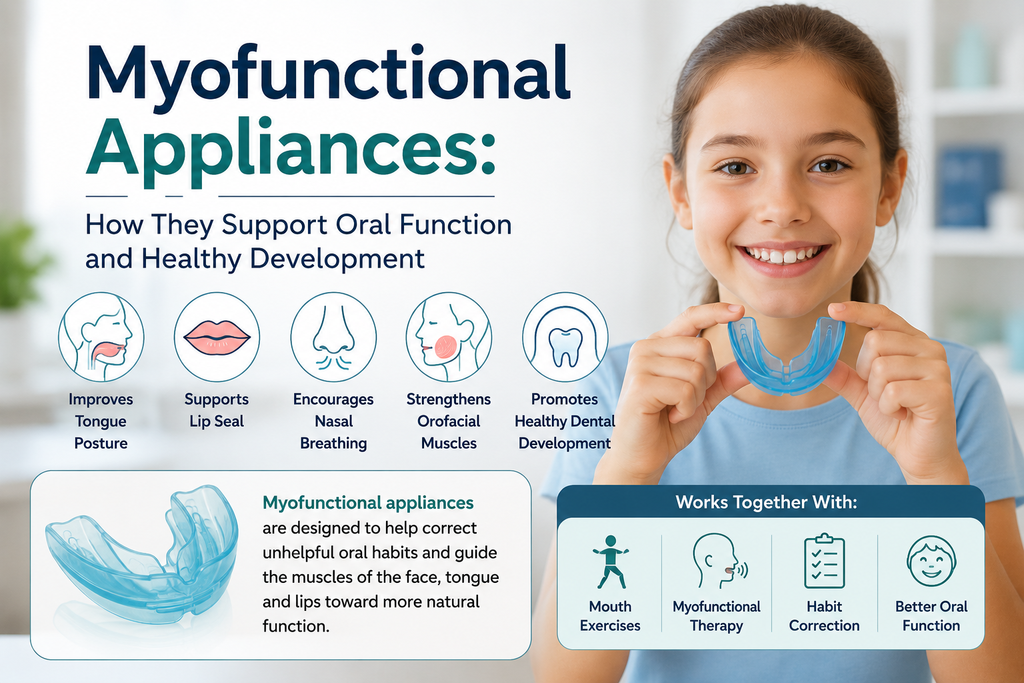
Myofunctional methods encompass myofunctional appliances. Myofunctional appliance therapy works on forming, sub-dividing or altering oral muscle function and/or resting habits. The use of therapy and appliances will depend on the patient, the appliance itself, and the type of orthodontic procedures to be done.
Crooked teeth, problematic breathing, and jaw development are chronic issues of daily living. Although they can provide some relief, these appliances are not a long term solution to these issues. The appliances are most appropriate when a patient has functional or structural problems to begin with.
Why Does Oral Muscle Function Matter?
Healthy oral function happens when multiple structures work together. Vestibular and lingual muscles play their role during speech and swallowing, lips aid in closure of the oral cavity, and the jaw and muscles of mastication perform the act of eating. Breathing even influences how the mouth relaxes.
A person who rests their mouth open has trouble maintaining lip closure and pushes their tongue forward while swallowing, and has an oral pattern that is not optimal and may be also due to problems with the dentition system. Though a cause and effect relationship cannot be assumed, these problems do occur at the same time.
A more closed resting posture occurs when breathing occurs through the nose with closed lips, with teeth slightly apart, and position of the tongue which is dependent on the individual.
The example given is one of many reasons to consider both structure and function when addressing oral issues. Looking at the teeth may be insufficient.
What Role Do Mouth Exercises Play?
Appliances and exercises integrating mouth awareness and coordination have been used in a variety of ways to strengthen the muscles of facial and oral regions.
Mouth exercises can vary, from concentrating on movement and awareness of the tongue, to awareness of the lips, or coordination of movements of the muscles during swallowing.
An example of an exercise to increase awareness of the tongue rest position might be to have the client place a fingertip inside their mouth to feel where the tongue rests in the mouth. Another example might be to practice a particular kind of tongue movement, while letting the lips relax.
These exercises are not merely general fitness exercises for the mouth, like traditional resistance training for the muscles of the mouth. They are more tailored to an individual’s pattern of functioning and ability to perform the exercise.
ASHA outlines exercises and activities that may potentially target tongue, lip, and jaw rest awareness, as well as closed mouth resting posture and nasal breathing, when appropriate. ASHA also stresses targeting potential airway or structural issues that can interfere with normal function, when needed.
The reasoning behind this is that a functional exercise to improve posture of the tongue, as an example, may not solve the more pressing issues.
How Myofunctional Therapy Supports Oral Muscle Function
Individualized therapy may target various oral habits and functions like tongue posture, lip closure, swallowing, chewing and breathing. Myofunctional therapy is described as treatment by structured exercises and targeting habitual patterns of the muscles and functions of the mouth and face.
Treatment may require an interdisciplinary approach when there are concerns involving the teeth, airway, speech and swallowing. This does not mean that a person has to try to hold their tongue or lips in a certain position all day. Functional awareness and patterns may be targeted and refined through treatment.
There is still early stage research to support these methods. Some published reviews have noted changes in selected areas; however, there continues to be significant variability in the delivered methods and studies of low quality. For example, in one recent review, while many/most studies found improvements, the overall evidence was insufficient to support the effectiveness of the methods across the various conditions studied.
Why Age and Development Matter
Age affects how oral structures develop and how we plan treatment. While children continue to develop their teeth and jaws, adults have various structural and orthodontic issues.
There can be many reasons for a child’s persistent mouth breathing and an atypical swallow or inability to keep a rest posture. These may be symptoms of nasal congestion or may be attributed to allergies, adenoid hypertrophy, habits, or bad dental relationships.
Selling an appliance online and not assessing the patient first is not appropriate.
If you’re exploring these options or have concerns about oral function, tongue posture, jaw development, or orthodontic treatment, consult a qualified orthodontist for a personalized evaluation and guidance.
Contact Dr. Mathesul Invisalign Orthodontist Braces & Dental Implant Clinic to discuss your concerns and understand which approach may be appropriate for you. Take the first step toward better oral health and informed orthodontic care.
Call us today at 8983101099 or email us at [email protected] to book your consultation. Take the first step toward better oral health and get professional guidance on your orthodontic treatment options.
Conclusion
Myofunctional appliances and mouth exercises are utilized in therapy to aid a patient’s swallowing, breathing and oral habits. They provide relief in cases caused by dysfunctional tongue posture and dysfunctional lip performance.
Therapy approaches for dysfunctional swallowing are tailored to a patient’s age and anatomy. Therapy for dysfunctional swallowing relies on the underlying cause of the dysfunction and may include a combination of appliances, exercises, and orthodontic treatments.
Knowledge of the functionality of the mouth as an integrated system is more praiseworthy than knowledge of a single appliance or exercise.
