

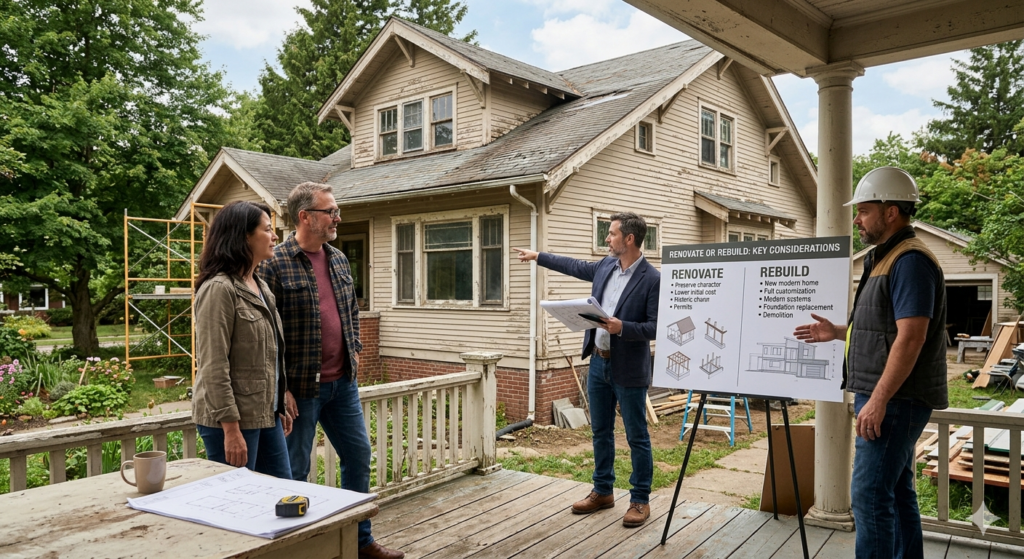
Sydney’s older suburbs are full of character homes: Federation cottages in Balmain, California bungalows in Ryde, post-war brick homes in the Inner West. They come with charm, established streets and good locations. They also come with cracked walls, outdated wiring and floor plans that don’t suit modern life. That leaves many owners asking whether to renovate or knock down and start again.
There is no universal answer, but the numbers and the risks can be compared. If you’re leaning towards keeping the existing structure, it’s worth talking early with a team that offers professional home renovation services, because an experienced builder can assess the frame, foundations and hidden problems before you commit to a direction. That assessment often decides the whole question.
What Renovating Typically Costs
A renovation keeps your existing structure, so you skip demolition and a new slab, and you often keep the original plumbing and services. As a rough guide, a major renovation of an older Sydney home commonly falls between $1,500 and $3,500 per square metre, depending on scope and finishes. A kitchen and bathroom refresh sits at the lower end, while structural changes, extensions and full internal reconfigurations push towards the higher end.
The main advantage is control. You can stage the work, prioritise the most urgent areas and spread costs over time. Renovations can also be faster to approve, particularly when the work is internal or stays within your existing footprint.
The main risk is the unknown. Once walls open up, older homes can reveal termite damage, rotting stumps, outdated wiring, asbestos-containing materials or failing plumbing. A sensible renovation budget includes a contingency of 10 to 20 per cent for exactly these surprises.
What Rebuilding Typically Costs
A knock-down rebuild in Sydney generally starts at around $3,000 to $5,000 or more per square metre for a quality custom build. On top of that, you’ll need to budget for:
- Demolition and site clearing, often $20,000 to $50,000 or more, higher if asbestos is present
- Temporary accommodation for 12 to 18 months
- Design, engineering, soil testing and council approvals
- Landscaping, driveways and fencing, which are often forgotten in early budgets
The trade-off is certainty of outcome. You get a modern, energy-efficient home built to current codes, with a layout designed around how you live. Fixed-price contracts can also make the build cost more predictable than a renovation full of unknowns.
Hidden Factors That Shift the Numbers
Heritage and conservation rules. Many older Sydney suburbs sit within heritage conservation areas. Demolition may be restricted or refused outright, and even where a rebuild is allowed, design controls can add cost and time. Check your council’s planning controls before you fall in love with either option.
Structural condition. If your home has significant foundation movement, widespread termite damage or a failing frame, the cost of repairing it can approach the cost of rebuilding. A structural engineer’s report is a small expense that can save you from a very large mistake.
Living arrangements. Renovating in stages sometimes lets you stay in the house, which saves on rent. Extensive works, however, may still force you out. Rebuilding almost always does.
Timeframes. A full rebuild, including design and approvals, can take 18 months to two years from start to finish. Renovations are often quicker, though extensive ones can also drag on if approvals or hidden issues arise.
The 70 Per Cent Rule of Thumb
Many builders use a simple benchmark. If the cost of renovating exceeds roughly 60 to 70 per cent of the cost of a comparable new build, rebuilding usually makes more financial sense. Beyond that threshold, you’re paying near-new prices while still living with an old structure’s limitations.
The rule isn’t perfect. It doesn’t account for heritage value, emotional attachment or the streetscape appeal of your home. But it’s a useful starting point for a realistic conversation.
Which Option Suits Which Owner?
Renovating tends to suit owners who love the home’s character, have a sound structure to work with, want to limit disruption or need to stage costs over time. Rebuilding tends to suit owners whose home has serious structural problems, who want a fully modern layout and energy performance, or whose block is large enough to support a design the existing house simply can’t accommodate.
Final Thoughts
The right choice depends on your budget, your block and the condition of what’s already there. Get an independent building inspection, request itemised quotes for both pathways and check your council’s heritage and zoning restrictions before deciding. A clear comparison, built on real numbers rather than assumptions, will protect both your budget and your peace of mind.
