

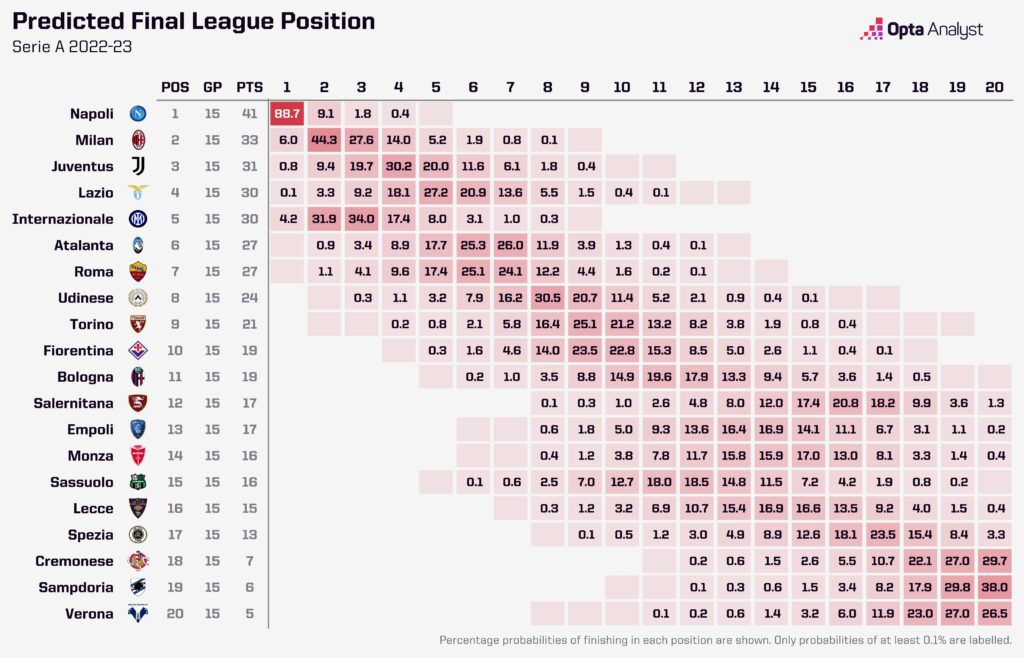
The final Serie A 2022/23 standings are more than a list of positions; they’re a compressed summary of how 20 teams handled 38 games of pressure, variance and tactical choices. For bettors, the table becomes useful only when you read it as evidence about how often teams met, exceeded or fell short of expectations rather than as a simple ranking of “good” and “bad” sides.
How Overall Standings Translate into Betting Baselines
At the simplest level, the table tells you who consistently turned performances into points, which shapes default pricing for the next season. Napoli finished first with 90 points (28 wins, 6 draws, 4 losses) and a 77–28 goal record, followed by Lazio on 74 points (60–30), Inter on 72 (71–42) and Milan on 70 (64–43). At the opposite end, Verona and Spezia both finished on 31 points with identical 31 goals scored, but with 59 and 62 conceded respectively, while Cremonese and Sampdoria ended with 27 and 19 points and goal differences of −33 and −47. These numbers set a baseline story: some clubs earned their status as clear favourites, some functioned as mid-table spoilers, and others proved that backing them as strong favourites would, on average, be a losing idea.
What Points Totals Say About Reliability and Ceiling
Points totals alone hint at two key betting questions: how often does a team avoid defeat, and how often does it actually turn superiority into wins. Napoli’s 90 points included 28 wins, showing a high conversion of performances into three points; Lazio’s 74 points came from 22 wins and 8 draws, suggesting a team that also handled tight games efficiently; Juventus, despite penalties off the field, still posted 22 wins, 6 draws and 10 losses for 62 points; Bologna in ninth accumulated 54 points, which is a strong return for a “smaller” club. Bettors can treat these totals as indicators of reliability: teams clustered around 70+ points were usually safe anchors in certain contexts, while those around 50–55 points, like Bologna and Torino, showed enough competence to justify support at the right prices. Conversely, sides stuck in the low 30s or below, such as Verona, Spezia, Cremonese and Sampdoria, rarely offered trustworthy favourite profiles, even if they occasionally delivered upsets.
Goal Difference: Separating Dominance from Survival
Goal difference refines what points totals tell you by revealing whether a team’s results came from narrow margins or sustained control. Napoli’s +49 (77 scored, 28 conceded) and Inter’s +29 (71–42) indicate sides that not only won often but tended to win by clear gaps; Milan (+21), Atalanta (+18), Roma (+12) and Juventus (+23) also posted double-digit positive differentials, confirming that their overall performance matched their status near the top. In contrast, mid-table Bologna (+4) and Torino (+1) earned solid points with far thinner margins, and teams like Sassuolo (−14), Salernitana (−14) and Lecce (−13) survived despite conceding much more than they scored. For betting, positive goal difference in the top half supports more confidence in handicap or win markets when the price is reasonable, while small or negative differentials push you toward more cautious positions, such as double chance or goals markets, rather than aggressive scoreline expectations.
Goals Scored and Conceded: Choosing Between Result and Total Goals Bets
Goals for and against help bettors decide whether to prioritise result markets or totals. Napoli and Inter were the only teams to break 70 goals (77 and 71 respectively), with Milan on 64 and Atalanta on 66, signalling consistently dangerous attacks that could justify overs or team-total bets when facing weaker defences. On the defensive side, Lazio’s 30 goals conceded and Juventus’s 33 marked them as the strongest rearguards, which often anchored under-related bets or narrow-margin wins. Lower down, Salernitana’s 62 goals conceded, Spezia’s 62, Cremonese’s 69 and Sampdoria’s 71 underscored how vulnerable some teams were, pointing toward goal-heavy matches when they faced competent attacks. The implicit lesson is that the table’s for/against columns provide a first filter for whether a match is better approached through sides, totals, or avoidance.
Comparing Top and Bottom Through a Simple Lens
Side-by-side comparisons make the table’s implications more concrete for bettors weighing specific matchups. A club with a +49 goal difference, 77 goals scored and 28 conceded carries a fundamentally different risk profile than one with −31 and 31–62, even if both occasionally produce surprising results. In practical terms, the former can justify being a short-priced favourite in more situations, while the latter might be best approached through opposing bets or goal-based markets that exploit its structural weakness. When you think in this comparative way, the table becomes a map of where you can reasonably expect sustained superiority, where variance dominates, and where price must compensate for chronic fragility.
How the Table Highlights Mid-Table “Value Teams”
The middle of the Serie A table is often where underappreciated betting opportunities live. Bologna’s 54 points and +4 goal difference, Torino’s 53 points and +1, Monza’s 52 points and −4, and Udinese’s 46 points and −1 paint a group of sides that competed well, especially at home, and frequently pushed top teams harder than their brand profile suggested. These numbers show that, in 2022/23, several mid-ranked clubs avoided long losing runs and prevented heavy defeats, even when facing title contenders, which made them attractive on handicaps, double chance or draw markets when odds still treated them as clear underdogs. Bettors who recognised this mid-table resilience could pick spots where public perception and table position diverged—particularly in games where motivation and schedule favoured the lesser name.
What the Bottom of the Table Warns About Relegation Sides
The relegation zone offers a different 168 ยูฟ่าเบท set of warnings, especially for bettors tempted by big prices. Verona and Spezia both finished with 31 points and identical 31 goals scored, but conceded 59 and 62 respectively, while Cremonese’s 36–69 record and Sampdoria’s 24–71 highlighted persistent issues at both ends of the pitch. These patterns indicate that, across the season, these teams rarely showed the sort of structural balance that would justify frequent backing, particularly as favourites or in matches where they needed to chase wins. However, because their problems were obvious, bookmakers often priced them as clear underdogs, which meant occasional value could appear when they faced tired or heavily rotated opponents; the table’s role here is to remind you that such bets must be rare and price-driven rather than emotional hunches based on sympathy or short-term form.
How Expected-Goals Data Adjusts Your Reading of the Table
The raw table can mislead if you ignore underlying metrics that show how sustainable a team’s results really were. Midseason work on expected goals showed that Udinese and Lazio were notable outperformers in attack, with goals totals significantly above their xG, while Empoli and Salernitana overperformed in terms of expected points and expected goals against, thanks in part to strong goalkeeping and some favourable variance. At the same time, Inter and Roma were identified as underperformers in defence, conceding more goals than their xGA suggested, meaning their table positions slightly understated how solid they actually were. For bettors, incorporating this layer means treating some mid-table or overperforming sides—Empoli, Salernitana—more cautiously than their final points might imply, and being open to the idea that certain top clubs had more “true strength” than the table alone reflected.
Using a Betting Platform Interface to Read the Table in Context
In real-world betting, you rarely stare at the table in isolation; you see it embedded in an online context that shapes what you notice. Modern football markets often show abbreviated standings, form guides and goal summaries alongside odds, which can draw your eye toward narratives—Napoli’s dominance, Lazio’s defence, Verona’s struggles—without forcing you to ask whether the price already reflects those stories. To counter this, some bettors first interpret the full table and underlying numbers offline, assigning each team a rough category—high-trust favourite, solid mid-table, volatile attacker, fragile relegation side—then carry that classification back into their betting platform of choice. That way, when a match pops up in the interface, you already have an independent view of what the table says about each club, and you can judge whether the odds align with that view or lean too heavily on public perception.
Why the Table Alone Is Not Enough for casino online Users
For people accessing football markets from the same account where they also use a casino online website, the table’s information has to compete with the faster, more emotional feedback loops of other games. A neatly ordered list of points and goal differences is easy to quote but harder to internalise when recent casino wins or losses skew your risk tolerance on weekend Serie A fixtures. If a sudden loss elsewhere pushes you to chase recovery, the clear message of the table—that backing Sampdoria or Cremonese as favourites is structurally unsound, or that Empoli’s relative success depended on outperformance unlikely to persist—can be ignored in favour of short-term narratives. For bettors who want to treat the 2022/23 table as a genuine guide, separating slow, evidence-based decisions from fast, variance-driven gambling is essential, because otherwise the discipline implied by the standings never turns into disciplined staking.
Summary
The 2022/23 Serie A table tells bettors that dominance at the top (Napoli, Lazio, Inter, Milan), mid-table resilience (Bologna, Torino, Monza, Udinese) and chronic weakness at the bottom (Spezia, Verona, Cremonese, Sampdoria) are not just stories but quantifiable patterns in points, goals and goal difference. When combined with expected-goals insights and an awareness of how betting interfaces and parallel gambling activities influence behaviour, that table becomes a starting point for classifying teams into trust levels, suitable market types and stakes, rather than a decorative statistic. For anyone looking to improve their Serie A betting, the key is to treat the standings as a map of long-term tendencies and limits, not a weekly prediction engine.
